
You press the window switch and… nothing. Or maybe you hear something happening inside the door, but the glass barely moves. Sometimes the window starts down normally and then tilts sideways. Other times it simply drops into the door.
When a power window stops working, two parts usually get most of the attention: the window motor and the window regulator. They work together, but they do very different jobs. And while certain symptoms can point toward one or the other, there are several other things that can cause a power window to quit.
Here’s a practical look at what’s happening inside the door and what Tallahassee drivers may notice when something starts to fail.
What Does the Power Window Motor Do?
The motor is the electrical part of the system. When you press the switch, power is sent to the motor, which turns in one direction to raise the window and the other direction to lower it.
It’s a small motor, but it has to move a fairly heavy piece of glass over and over again. After years of use, the motor can wear out, develop an intermittent problem, or simply stop working.
A failing motor may give you some warning. The window might move more slowly than it used to, work only occasionally, or stop partway through its travel. But a completely silent window does not automatically mean the motor is bad. A failed switch, fuse, wiring connection, or other electrical problem can produce the same symptom.
What Does the Window Regulator Do?
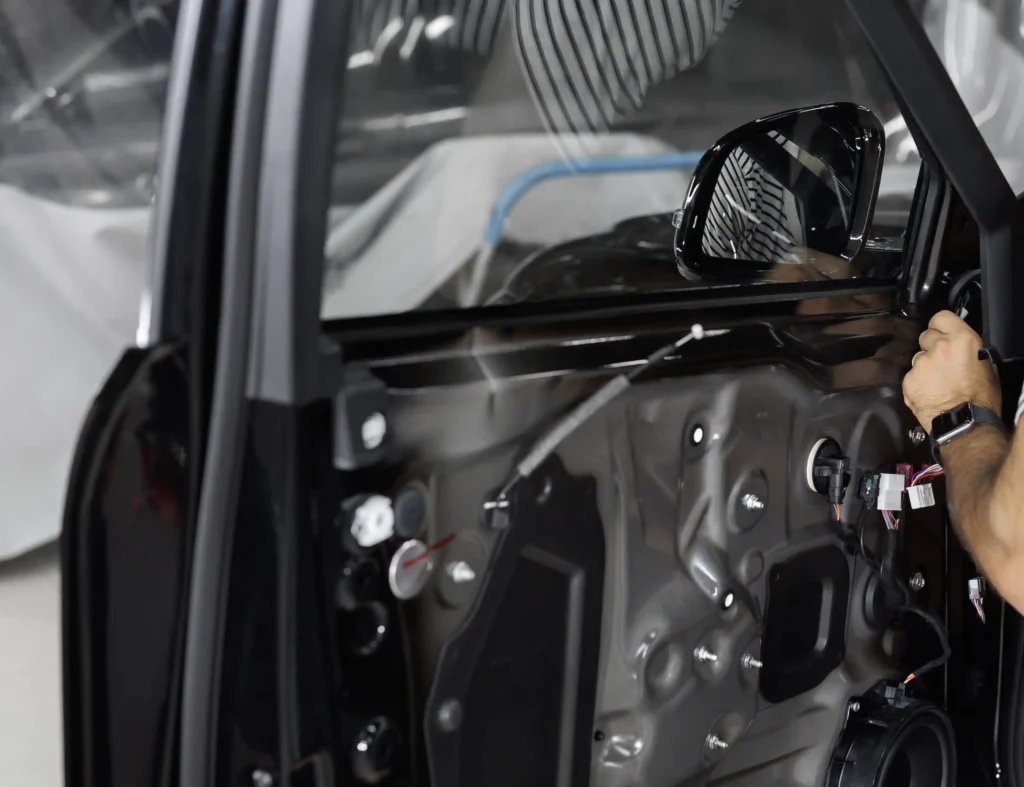
The regulator is the mechanism that actually guides the glass up and down inside the door.
Depending on the vehicle, the regulator may use cables, gears, tracks, arms, or a combination of those parts. Its job is to keep the glass moving smoothly and properly aligned as the motor operates.
When a regulator fails, the motor may still be perfectly fine.
That’s why a window that makes noise but doesn’t move normally can be an important clue. You may hear the motor running while the glass stays put, moves crookedly, or slips back down into the door.
Signs the Window Regulator May Be the Problem
A damaged regulator often causes more mechanical-looking symptoms than an electrical failure. You may notice:
- The window tilts forward or backward while moving.
- The glass drops down inside the door.
- You hear grinding, crunching, popping, or cable-like noises.
- The motor can be heard running, but the glass does not move.
- The window moves partway and then binds.
- You have to help the glass up by hand while operating the switch.
If the glass is visibly crooked, forcing the switch repeatedly usually isn’t a good idea. A binding regulator can put additional strain on the motor and other parts inside the door.
Signs the Power Window Motor May Be Failing
A worn motor can behave differently.
The window may become noticeably slower, especially when raising the glass. It may work one time and refuse to work the next. In some cases, the motor eventually stops responding altogether.
There’s an important catch, though: those symptoms aren’t exclusive to the motor.
Electrical connections, switches, wiring, and a regulator that is creating too much resistance can all affect how the window behaves. That is why replacing parts based solely on one symptom can turn into an expensive guessing game.
What If the Window Doesn’t Move at All?
A completely dead window can have several causes.
If just one window is affected, the problem could be the motor, regulator, switch, wiring, or a connection inside that particular door. If several windows stop working at once, the cause may be somewhere else in the electrical system, such as a fuse or master switch.
There are also situations where the window works from one switch but not another. For example, it may respond to the driver’s master controls but not the switch on the passenger door. That can point toward a switch-related problem rather than the motor itself.
The symptoms help narrow things down, but inspection is usually the best way to determine what actually failed.
Can You Keep Driving With a Broken Power Window?
That depends partly on where the glass is stuck.
A window that is closed and simply won’t open is inconvenient, but a window stuck several inches down creates a more immediate problem. In Tallahassee, an afternoon rainstorm can turn a stuck-open window into a wet seat, soaked door panel, and a much bigger headache in a hurry.
There’s also the obvious security issue if the vehicle cannot be closed properly.
If the glass has dropped inside the door or is sitting crooked in the opening, it is worth having the problem looked at rather than repeatedly trying the switch. The issue may be relatively straightforward, but continued operation can make a damaged mechanism worse.
Motor, Regulator, Switch…or Something Else?
This is where power-window problems can be frustrating.
The symptom you see from the driver’s seat may be caused by a part hidden behind the door panel. Two different failures can look remarkably similar from the outside.
That’s also why we wouldn’t recommend assuming you need a motor simply because the window is dead, or assuming you need a regulator because you can hear a noise inside the door.
If your car window won’t go up, we’ve also put together a broader guide covering some of the first things worth checking: Car Window Won’t Go Up? What Tallahassee Drivers Should Check First.
Power Window Repair in Tallahassee
Seminole Auto Glass provides power window repair in Tallahassee for cars, trucks, and SUVs. That includes diagnosing problems involving window motors, regulators, and the other components that allow the glass to move properly inside the door.
If your window is moving slowly, sitting crooked, making an unusual noise, or refusing to move at all, the best next step is to find out what actually failed before replacing parts.
You can request a quote online or call 850-539-4527. Seminole Auto Glass is located at 1500-5 Capital Circle SE in Tallahassee.
One Last Thing
If your power window is acting strangely, pay attention to exactly what it is doing before the problem gets worse. Does the glass tilt? Can you hear the motor? Does it work from one switch but not another? Does it move slowly only when going up?
Those details can be surprisingly useful when it is time to diagnose the problem.
And if the window is stuck open with a Tallahassee thunderstorm building in the distance, that diagnosis suddenly becomes a lot more urgent.

